

On 1 October 2026, French biotech firm AFYREN (Euronext: ALAFY) officially announced its collaboration with South African microbiome skincare brand Esse Skincare to launch Barrier Rescue, a barrier-repair cream. This marks the world’s first skincare formulation featuring fermented, 100% biobased propionic acid as its primary bioactive functional ingredient.
The announcement was picked up by leading international beauty trade outlets including Personal Care Insights, Home & Personal Care Middle East & Africa, The Microbiologist, and renewable carbon news platform Renewable Carbon News.
The raw material holds COSMOS natural and organic certification. The launch is noteworthy because it upends a decades-long industry convention: propionic acid has long been viewed exclusively as a preservative in cosmetic formulations. Whereas alpha-hydroxy acids and salicylic acid are widely recognised for exfoliating skin and accelerating surface cell turnover, propionic acid is now emerging not merely as an antimicrobial stabiliser, but as an ingredient with validated microbiome skincare benefits.
Propionic Acid: Long Regarded Merely as a Cosmetic Preservative
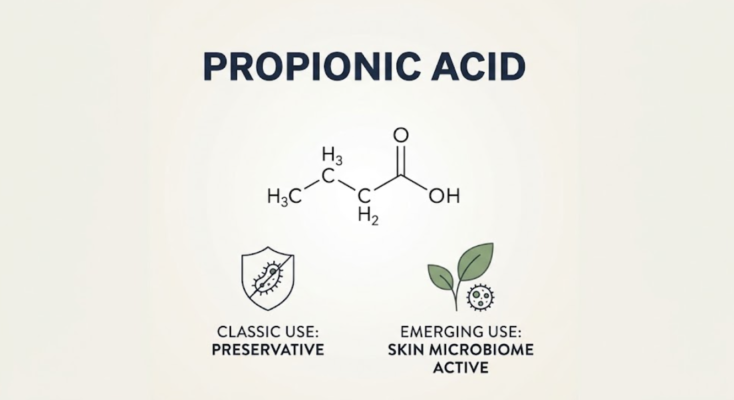
Propionic acid is a three-carbon short-chain saturated fatty acid with the molecular formula C₃H₆O₂, structural formula CH₃CH₂COOH and molecular weight of 74.08. At ambient temperature, it appears as a colourless liquid with a characteristic pungent, rancid odour, making it readily identifiable. It is fully miscible with water and has an atmospheric boiling point of approximately 141 °C.
As an organic acid, its antimicrobial efficacy is heavily pH-dependent. Under acidic conditions, it selectively suppresses the proliferation of moulds and bacteria. For this reason, it has historically been deployed in cosmetic recipes as a preservative, biocide and pH adjuster. The EU CosIng database lists its cosmetic functions as antimicrobial, preservative, fragrance and pH regulator. China’s National Medical Products Administration (NMPA) Catalogue of Used Cosmetic Raw Materials (2021 Edition) adopts the same classification. Fewer than one hundred cosmetic products legally filed in China contain propionic acid, and a substantial share of those filings have since been cancelled.
A review of global formulation databases shows propionic acid has most commonly appeared in colour cosmetics. MAC Studio Fix Soft Matte Foundation Stick and Wander Beauty On-The-Glow Blush and Illuminator both list propionic acid for preservation purposes. Within skincare, older formulations such as NeoGenesis Salicylic Acid Gel and AVON Clearskin Deep Pore Cleansing Scrub once incorporated the compound solely to protect products from spoilage, rather than modulate the cutaneous microbiome. This raises a pivotal question: how can an ingredient traditionally used to kill contaminating microbes and extend shelf life be repositioned as a microbiome repair active? The answer lies in major advances in cosmetic R&D over recent years.
Why Propionic Acid Was Not Previously Deployed to Modulate the Native Skin Microbiome
Can propionic acid deliver microbiome skincare benefits? For many years, the cosmetic industry operated under a broad assumption that its broad-spectrum antimicrobial action conflicted with core microbiome principles — though this did not mean the molecule lacked biological potential.
As the goals of microbiome-focused skincare gained wider traction, formulators began exploring a broader range of ingredient possibilities. Microbiome skincare centres on sustaining stable commensal skin flora, nurturing beneficial microbes and dampening pro‑inflammatory signalling.
When utilised as a preservative, propionic acid exerts broad-spectrum microbial inhibition. At typical preservative loading rates, it cannot distinguish between pathogenic microbes and beneficial commensal bacteria resident on skin, suppressing microbial activity indiscriminately. Non-selective microbial suppression disrupts the skin’s native microbiome entirely.
This gave rise to a widely accepted industry consensus: ingredients formulated for broad antimicrobial preservation are generally unsuitable for tuning native skin flora. Accordingly, early microbiome skincare R&D largely avoided propionic acid, favouring more gentle alternatives including live probiotic strains, prebiotics, postbiotic fermentation filtrates and lactic acid.
What Changed to Enable Propionic Acid’s Use in Microbiome Skincare?
A landmark 2022 study published in the Journal of Experimental Medicine reshaped this understanding, uncovering substantial potential for propionic acid in cutaneous microbiome regulation.
The research was jointly led by Professor Wei Li’s team at Huashan Hospital, Fudan University, and Professor Xu Yao’s group at the Chinese Academy of Medical Sciences & Peking Union Medical College Hospital, Institute of Dermatology. Dr. Zhuoqiong Qiu served as first author; the research team included 14 investigators such as Zhulai Zhu and Xiaochun Liu. The paper, titled A dysregulated sebum–microbial metabolite–IL-33 axis initiates skin inflammation in atopic dermatitis, identified the sebum–microbial metabolite–IL-33 signalling axis as a key driver of atopic dermatitis pathogenesis.
The research team collected facial skin samples from healthy volunteers and patients living with atopic dermatitis (AD) for comparative analysis. AD patients exhibited markedly lower sebum levels and reduced cutaneous concentrations of microbially derived propionate compared with healthy controls. Subsequent studies using the MC903-induced murine AD model demonstrated that topical propionate application significantly reduced IL-33 release from keratinocytes and alleviated cutaneous inflammation. This modulatory effect operates via suppression of HDAC2/3 and activation of the AhR signalling pathway.
The team went on to run a small proof-of-concept clinical trial recruiting participants with mild-to-moderate atopic dermatitis. Topical application of propionate at physiologically relevant concentrations produced measurable reductions in lesion inflammation scores, without triggering large-scale microbiome disruption or irritation.
A core conclusion from the research establishes a clear threshold: dosage and intended application govern propionic acid’s biological outcome. At high inclusion rates used for preservation, propionic acid acts as a broad biocide targeting spoilage organisms inside a product. When deployed as a microbiome active, propionate is a naturally occurring metabolite produced by commensal skin bacteria such as Cutibacterium acnes. Applied at appropriately low, physiological concentrations, it does not eliminate beneficial skin flora; instead, it helps restore skin homeostasis.
Put simply, propionic acid functions as a “metabolic messenger” within the skin microbiome. Its preservative behaviour is a secondary effect observed at high concentrations, while its native biological role within the cutaneous ecosystem is anti‑inflammatory action and barrier regulation. Prior to this publication, the beauty industry focused exclusively on its antimicrobial capacity and overlooked its signalling function.
AFYREN CEO Nicolas Sordet stated in the December 2025 press release announcing the partnership: “This shows how biotechnology can unlock new opportunities for both performance and sustainability in cosmetics that bring real benefits to humans and the environment. We look forward to seeing the first products reach consumers.”
AFYREN Chief Commercial Officer Joachim Merziger added in media coverage following the Barrier Rescue launch: “This partnership shows how biotechnology can unlock new opportunities for both performance and sustainability in cosmetics, bringing tangible benefits for people and the planet. We are very proud to see the first products now reaching consumers.”
Esse Skincare founder Trevor Steyn has spent more than a decade researching the skin microbiome and is among the early pioneers advocating a shift from strain-centric formulation toward metabolite-led development. In a brand interview, he explained that early microbiome research heavily prioritised incorporating live bacteria, which face major stability and skin penetration limitations within cosmetic bases. His team’s work mapping sebum metabolic pathways revealed that supplementing metabolites naturally secreted by skin microbes, such as propionic acid, offers a more direct route to modulate inflammatory signalling.
Parallel Developments Among Chinese Raw Material Suppliers
Chinese ingredient manufacturers are also advancing work in this field.
At an ingredient showcase, Shanghai UniVOOK (Bailuo Hualian Chemical) shared that it has scaled production of 100% biobased propionic acid certified by SGS, manufactured through microbial fermentation. Nevertheless, under China’s cosmetic regulatory framework, propionic acid remains categorised solely as a preservative raw material. The sector faces a shared structural challenge: the chemical molecule itself is unchanged, yet formulation goals and R&D rationales have been completely reimagined. Regulatory raw material catalogues often lag behind emerging scientific discoveries around skin microbiology.
A senior R&D lead from Shandong Hongda Group noted at a cosmetic ingredients summit that the company has long produced fermented propionic acid derived from corn starch. Historically, customer demand was limited to mould inhibition and preservation. In recent years, the firm has received targeted enquiries from domestic Chinese skincare brands interested in testing propionic acid for barrier repair and microbiome applications, although standardised efficacy evaluation frameworks for these claims are still maturing.
Broader Industry Implications for Cosmetic Brands
Propionic acid’s evolution from preservative to microbiome active illustrates a broader paradigm shift within microbiome skincare R&D, carrying long‑term consequences for cosmetic businesses.
First, it opens a new innovation pipeline for existing, catalogued raw materials.
Traditional cosmetic ingredient innovation typically relies on discovering novel molecules and submitting new raw material filings — a slow, capital-intensive process. The propionic acid case demonstrates that many well-established organic acids, long labelled only as preservatives, pH adjusters or chelating agents, harbour untapped biological potential. This creates a low-cost, compliant microbiome development pathway for smaller Chinese brands that lack resources to file for new raw material approvals.
For context, AHAs were once understood purely as gentle exfoliants and pH modifiers. Researchers later confirmed lactic acid, a short-chain organic metabolite produced by epidermal lactobacilli, upregulates natural moisturising factor synthesis and sustains the skin’s weakly acidic defensive barrier. L’Oréal and its brand La Roche-Posay combine its “AP+M Microbiome Remodelling Technology” with low-dose lactic acid and postbiotics to support the skin barrier in patients prone to atopic eczema. Unilever-owned Gallinée builds its microbiome skincare portfolio around lactic acid and lactobacillus-derived postbiotics.
Second, the discovery signals a meaningful shift in the focus of microbiome R&D toward what many term the “metabolite era”.
Research priorities are moving beyond identifying which bacterial species colonise skin, toward investigating metabolites generated by those microbes, and how these metabolites regulate keratinocyte immunity and inflammatory signalling. Studies are becoming more quantitative and target‑driven.
Multiple research papers from Dr. Althea (Euromed, Freda Biotech) teams have been selected for presentation at IFSCC Congresses following this same research direction, mapping sebum–short-chain fatty acid feedback loops. The Freda Biotech group applies metabolomics to profile ratios of short-chain fatty acids and free fatty acids produced by epidermal microbes metabolising cutaneous sebum.
Shiseido has formalised its Skin Microbiome Focus strategy, centering research on glycerol and short-chain organic metabolites produced by Staphylococcus epidermidis. Its research centre confirmed that organic metabolites generated by beneficial skin bacteria activate keratinocyte receptors and upregulate expression of tight-junction proteins such as Claudin‑1. This research underpinned the repositioning of Shiseido’s d program range, formulated to boost production of beneficial microbial metabolites for targeted microbiome care.
Third, this trend introduces new commercial and compliance risks.
Brands must communicate clearly to consumers and regulators that the same ingredient delivers distinct effects depending on concentration and formulation pH: high-dose propionic acid preserves product integrity and shelf stability, while physiologically low concentrations support barrier repair, and these functions are not mutually exclusive. Within China’s filing system, propionic acid’s registered function remains preservation. Brands must strictly separate filing disclosures from marketing messaging to avoid unsubstantiated or exaggerated claims.
Clean beauty brands have frequently struggled with stability and spoilage risks associated with zero-preservative formulations. The Esse and AFYREN model leverages 100% biobased fermented propionic acid. In these formulas, the ingredient satisfies COSMOS / ECOCERT natural certification criteria while performing a dual role: mild auxiliary preservation at reduced loading alongside postbiotic‑like barrier repair activity.
It is reasonable to anticipate that as research on short-chain fatty acids expands, more conventional preservative organic acids will be re-evaluated and repurposed for novel skin benefits.
Leecosmetic: Using raw materials from internationally renowned companies
Contact: https://leecosmetic.com/contactus/
Reference List
- AFYREN Official Press Release: Global launch of cosmetic product based on AFYREN’s 100% natural propionic acid
- Personal Care Insights: Esse debuts Afyren petrochemical-free propionic acid in microbiome skin cream
- Qiu Z, et al. A dysregulated sebum–microbial metabolite–IL-33 axis initiates skin inflammation in atopic dermatitis. Journal of Experimental Medicine, 2022, 219(10): e20212397
- CosIng EU database entry for Propionic acid
- Renewable Carbon News: Global launch of cosmetic product based on AFYREN’s 100% natural propionic acid
- UniVOOK official product page for biobased propionic acid
- IFSCC – International Federation of Societies of Cosmetic Chemists, research abstract repository (short chain fatty acid & skin microbiome papers)
- Shiseido Skin Microbiome Research Program overview
- La Roche-Posay Microbiome Research & Postbiotic Science
- NMPA Catalogue of Used Cosmetic Raw Materials (2021 Edition official portal)
