
In traditional facial anti-aging, the industry has long relied on a “replenishment” strategy. This approach stems from the longstanding belief that skin aging is primarily driven by collagen loss, prompting endless efforts to top up collagen levels and inhibit its degradation.
Yet, for decades, sagging skin and facial laxity have remained among the most intractable challenges in dermatological research. To date, radical solutions seemed exclusive to surgical procedures such as SMAS facelifts [1]. However, cutting-edge dermatological research offers a fresh paradigm: skin firmness depends not merely on the quantity of collagen, but on its spatial architecture and biomechanical network—much like how sound architectural engineering relies on structural mechanics rather than raw materials alone.
What is Ring Collagen®? A Breakthrough in Dermatological Science
On July 6, 2026, cosmetics giant Shiseido announced [2] that its R&D team—in collaboration with top Japanese medical and research institutions—had identified a novel microscopic structure within the dermis using 3D imaging and biomechanical analysis: Ring Collagen®. The scientific effort was led by Dr. Kyoichi Matsuzaki, Professor and Chairman of the Department of Plastic and Reconstructive Surgery at the International University of Health and Welfare [3].
Preliminary findings were first presented in September 2022 at the 32nd International Federation of Societies of Cosmetic Chemists (IFSCC) Congress in London, where the paper stood out among hundreds of global entries to earn a prestigious spot as a Top 10 Finalist [4].
The true significance of Ring Collagen® lies in shifting anti-aging research from simple “molecular synthesis” to the realm of tissue mechanobiology. Going forward, efficacy evaluation will expand to assess spatial collagen alignment and mechanical stress states within tissue. This breakthrough also redefines R&D strategies, paving the way for integrated anti-sagging solutions that combine transdermal delivery, physical mechanostimulation (e.g., microcurrent devices or specialized massage techniques), and microenvironmental repair.
How Ring Collagen® Restores Facial Tension
Research reveals that collagen fibers in the deep dermis are far from a random meshwork; instead, they form dense, circular rings around vellus hair follicles and sebaceous glands. The research team officially named these micro-structures Ring Collagen®.
Microscopic Self-Contraction: Individually, each collagen ring acts as a self-contracting micro-tension ring.
Macroscopic Network Traction: Collectively, countless rings anchor to one another through the surrounding extracellular matrix, weaving a dynamic tension network that maintains facial contours.
Consequently, the biomechanical pathway of skin aging becomes clear:
【Youthful State】Intact Ring Collagen® + Abundant Proteoglycans ➔ Inter-ring Traction ➔ Continuous Dynamic Tension Network ➔ Firm Skin & Defined Contours
【Aging Pathway】Aging / Extrinsic Stressors ➔ Proteoglycan Depletion Around Rings ➔ Disruption of Ring Alignment➔ Collapse of Internal Tensile Strength➔ 【Macro Manifestation】 Facial Sagging & Structural Laxity
Important Distinction: Ring Collagen® is neither a newly discovered molecular type of collagen nor a raw cosmetic ingredient for topical application. Rather, it represents a specific 3D spatial conformation of collagen fibers in dermal tissue. While it does not yield an immediate cosmetic raw material, its long-term theoretical value is profound.
Leveraging ex vivo 3D biomechanical analysis and histological observation via Digital-Skin Reality® technology, researchers proposed that perifollicular cells, Wnt16 signaling pathways, proteoglycans, and Ring Collagen® alignment together constitute a functional Mechanobiology Unit that preserves skin biomechanical equilibrium [5].
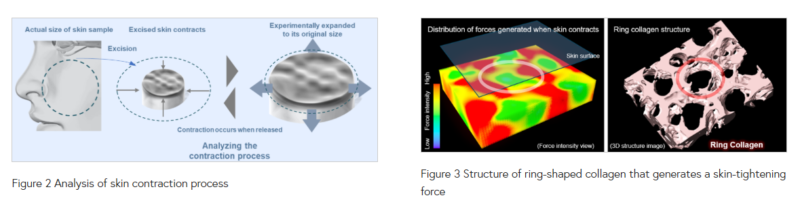
Image source: Shiseido official website
Part 01 | Current Anti-Aging Targets: Theory vs. Clinical Reality
Before evaluating this new target, it is essential to map out the current scientific baseline of skin anti-aging. Strictly speaking, there is no universally certified “official list of anti-aging targets” endorsed by a single authority.
Current mainstream research largely aligns with the Hallmarks of Aging (updated in 2023) [6]—encompassing genomic instability, epigenetic alterations, loss of proteostasis, disabled macroautophagy, cellular senescence, mitochondrial dysfunction, and chronic inflammation. While these hallmarks explain why cells age, they do not automatically equate to proven clinical efficacy in topical skincare.
Within established skincare science, only three avenues boast robust, indisputable clinical evidence:
1.Photoprotection (Sunscreen): UV radiation directly causes DNA damage, chronic inflammation, and massive collagen breakdown. Long-term randomized controlled trials (RCTs) demonstrate that daily broad-spectrum sunscreen use reduces skin photoaging progression by 24% over 4.5 years compared to discretionary use [7].
2.Retinoids: By binding to nuclear receptors, retinoids regulate epidermal turnover and dermal collagen remodeling. Systematic reviews and multiple RCTs confirm their efficacy in improving fine lines and hyperpigmentation; however, even FDA-approved prescription retinoids cannot reverse intrinsic aging or erase deep structural sagging [8].
3.Extracellular Matrix (ECM) Metabolism: Strategies targeting Type I and III collagen synthesis, MMP (matrix metalloproteinase) inhibition, and the maintenance of hyaluronic acid and proteoglycan microenvironments [9].
In contrast, trendy mechanisms like senolytics, SASP inhibition, NAD+ boosting, mTOR regulation, and autophagy enhancement—while promising in vitro and in animal models—lack the clinical maturity of sunscreens and retinoids for topical human applications.
Part 02 | Discovering Ring Collagen®: Translating Mechanical Structure into an Anti-Aging Target
Traditional anti-aging paradigms focus primarily on collagen quantity, synthesis rates, and protection against enzymatic degradation.
Ring Collagen® introduces a paradigm-shifting hypothesis: Even if dermal collagen density is sufficient, disordered spatial alignment prevents the formation of an effective tension network, rendering anti-aging efforts inadequate against sagging.
| Paradigm | Focus Area | Core Mechanism |
| Traditional Approach | Molecular Accumulation | Collagen Quantity + Degradation Protection |
| Ring Collagen® Breakthrough | Tissue-Level Network | Spatial Architecture + Mechanical Tension |
From a classification perspective, Ring Collagen® is not a top-tier hallmark of aging like mitochondrial dysfunction or genomic instability. Instead, it serves as a more direct, tissue-level mechanical target. While top-tier hallmarks explain cellular damage at its root, Ring Collagen® reveals how micro-scale damage translates into macro-scale facial sagging.
What makes this research particularly inspiring is its holistic view linking the pilosebaceous unit, proteoglycans, and collagen networks. In vitro studies show that moderate multidirectional mechanical stretching increases proteoglycan production in cultured skin, enhancing ring integrity. Furthermore, botanical extracts such as rosehip and safflower upregulate proteoglycan-related gene expression [10].
This suggests future anti-sagging solutions will evolve into integrated protocols: Targeted Delivery + Physical Mechanostimulation (Devices/Massage) + Biomechanical Evaluation.

Part 03 | A Rational Perspective: Bridging the Gap from Discovery to Commercial Reality
While Ring Collagen® opens an exciting new avenue, a rigorous scientific perspective requires a realistic assessment of its current development stage.
1. A Scientifically Validated Discovery, Not a Marketing Gimmick
By integrating facial tissue histology, ex vivo 3D biomechanical modeling, and in vitro skin cultures, the research confirms the physical existence and functional significance of Ring Collagen®, as acknowledged by its recognition at prestigious forums like the IFSCC [4].
2. Hurdles to Commercialization and Clinical Application
Lack of Independent Replication: Currently published data originates primarily from a single research group; independent, large-scale replication across global institutes is still pending.
Transdermal Delivery Challenges: Ring Collagen® resides in the deep dermis around hair follicles. Whether topical actives can effectively penetrate the epidermal barrier to reach and act on this target remains unproven.
Absence of Human Clinical Data: Evidence supporting proteoglycan upregulation or structural remodeling stems mainly from ex vivo and in vitro models. Large-scale, double-blind clinical trials demonstrating that topical interventions can rebuild Ring Collagen® and visibly lift sagging human skin are yet to be conducted.
Leecosmetic: Using raw materials from internationally renowned companies
Contact: https://leecosmetic.com/contactus/
Conclusion
The discovery of Ring Collagen® offers a fresh blueprint for skincare R&D. It serves as a compelling reminder that evaluating skin aging must transcend simple collagen quantification to encompass spatial architecture, proteoglycan microenvironments, and tissue tension states.
References
1.Mendelson, B. C., & Wong, C. H. (2012). Anatomy of the aging face and its relevance to aesthetics. Facial Plastic Surgery Clinics of North America, 20(2), 107–117.
2.Shiseido Company, Limited. (2026, July 6). Shiseido Discovers “Ring Collagen®”: A Novel Biomechanical Target in the Dermis Underlying Facial Sagging. Official Corporate Press Release. Tokyo, Japan.
3.International University of Health and Welfare (IUHW). (2024). Faculty & Clinical Profile: Dr. Kyoichi Matsuzaki, Department of Plastic and Reconstructive Surgery. Tokyo, Japan.
4.IFSCC Secretariat. (2022). Proceedings of the 32nd IFSCC Congress: Top 10 Paper Finalists (London, UK). International Federation of Societies of Cosmetic Chemists.
5.Shiseido Research Center & NIPS. (2022). Digital-Skin Reality® and 3D Mechanobiology of Perifollicular Dermal Architecture: The Wnt16 Signaling Axis and Proteoglycan-Mediated Ring Collagen Networks. Scientific Presentation at IFSCC 2022.
6.López-Otín, C., Blasco, M. A., Partridge, L., Serrano, M., & Kroemer, G. (2023). Hallmarks of aging: An expanding universe. Cell, 186(2), 243–278.
7.Hughes, M. C. B., Williams, G. M., Baker, P., & Green, A. C. (2013). Sunscreen and prevention of skin aging: A randomized trial. Annals of Internal Medicine, 158(11), 781–790.
8.Mukherjee, S., Date, A., Patravale, V., Korting, H. C., Roeder, A., & Weindl, G. (2006). Retinoids in the treatment of skin aging: An overview of clinical efficacy and safety. Clinical Interventions in Aging, 1(4), 327–348.
9.Quan, T., & Fisher, G. J. (2015). Role of age-associated alterations of the dermal extracellular matrix microenvironment in human skin aging: A mini-review. Gerontology, 61(5), 427–434.
10.Varani, J., Dame, M. K., Rittie, L., Fligiel, S. E., Kang, S., Fisher, G. J., & Voorhees, J. J. (2006). Decreased collagen production in chronologically aged skin: Roles of age-dependent alteration in fibroblast function and defective mechanical stimulation. The American Journal of Pathology, 168(6), 1861–1868.
