
As one of the most sought‑after anti‑aging actives, retinol’s market momentum has begun to shift. HBN, a Chinese anti‑aging skincare brand, has created a new anti‑aging molecule, Bakuchiol Ferulate, leveraging molecular‑structure reconstruction technology.
Recently, the Journal of Cosmetic Dermatology (JCD), a leading international peer‑reviewed cosmetic dermatology journal, published new research authored by the R&D team of Shenzhen Hujia Technology, HBN’s parent company. Overseas cosmetic‑technology outlet Personal Care Insights also covered the finding on August 6, 2026: HBN’s R&D team has successfully synthesised a novel molecule named Bakuchiol Ferulate (abbreviated as BF).
Cosmetic research from Shenzhen HBN Technology spotlights bakuchiol ferulate — a novel molecular hybrid synthesized from bakuchiol and a ferulic acid — as a stable, well‑tolerated, and effective alternative to anti‑aging retinol. Authors of the study highlight that retinol’s clinical utility as a potent wrinkle‑reducing active ingredient is often limited by its chemical instability and irritation for sensitive skin.
Plant‑derived bakuchiol is documented for its topical effects mimicking those of retinoids, as both compounds trigger similar gene expression pathways and similarly improve photoaged skin.
Unlike conventional “bakuchiol + ferulic acid” physical blends widely available on the market, BF chemically grafts the two moieties together via covalent bonding to form a brand‑new ester‑based molecular architecture. A PCT international patent covering this technology was formally published in March 2026, with priority dating back to September 2024. Industry insiders note this research marks HBN’s strategic transition from a downstream finished‑formulation player toward an innovator of proprietary cosmetic active molecules.

I. Why Conduct Molecular Re‑engineering on Bakuchiol?
Retinol and its derivatives have long been the gold‑standard actives for mitigating photoaging and enjoy strong market traction. They modulate key gene pathways to counter photo‑aging mechanisms and accelerate keratinocyte turnover. Most high‑potency anti‑wrinkle skincare lines from brands including SkinCeuticals, Neutrogena, Murad, HBN and Proya rely on retinoid‑class ingredients.
Nevertheless, retinol is far from perfect. While its anti‑aging potency is well‑established, it carries notable drawbacks: despite its high efficacy, it frequently triggers erythema, desquamation, stinging and skin‑barrier impairment. Its susceptibility to degradation triggered by light, heat and oxygen remains a persistent bottleneck for cosmetic scientists.
This technical challenge has proven hard to fully resolve. Chemically modifying retinol to break its conjugated double‑bond system improves stability yet erases its anti‑aging bioactivity. Nano‑encapsulation is another workaround: over‑tight encapsulation prevents the active from converting into bioactive retinoic acid within target skin layers, while insufficient encapsulation can unleash abrupt, severe cutaneous irritation.
Bakuchiol has therefore gained global popularity as a prospective retinol substitute. In a 12‑week double‑blind controlled clinical trial (44 subjects, 0.5 % bakuchiol vs 0.5 % retinol), bakuchiol delivered comparable improvements in hyperpigmentation and wrinkle reduction with substantially fewer adverse reactions such as erythema and peeling. Even so, bakuchiol’s status as a retinol alternative remains debated within academia. A 2024 systematic review covering 15 human clinical trials pointed out that 12 of those studies were uncontrolled open‑label trials and 10 utilised multi‑ingredient blends, leaving its standalone mechanism of action widely questioned.
Human Tolerability and Transcriptomic Analysis
Human tolerability was evaluated in a 14‑day cumulative patch test involving healthy adult volunteers. Multiple concentrations of BF ranging from 0.05% to 1.0% were compared with retinol concentrations of 0.05%, 0.1%, and 0.3%. All BF formulations were classified as nonirritating based on their Mean Cumulative Irritancy Index (MCII), including the highest 1.0% concentration. In contrast, 0.3% retinol was classified as slightly irritating, while lower retinol concentrations remained nonirritating.
HBN pursued an alternative approach. Instead of simple crude plant‑extract utilisation, the team performed molecule‑level modification: ferulic acid, an antioxidant moiety, is chemically bonded to bakuchiol through esterification. This preserves the original anti‑aging signalling pathways of bakuchiol while resolving its inherent technical limitations.
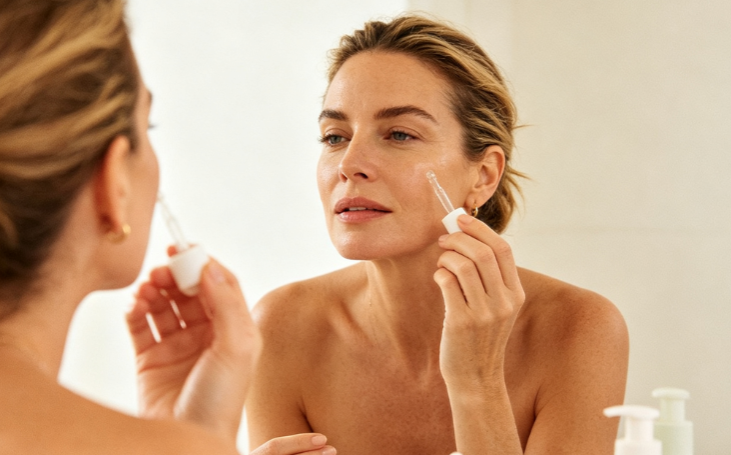
II. Measured Performance of Novel Anti‑Aging Molecule Bakuchiol Ferulate
Experimental data published in JCD and associated patent filings demonstrate BF’s strong performance across multiple test metrics:
- 90‑day light‑stability test: Under continuous solar‑irradiation conditions, BF retains over 86 % of its initial bioactivity — roughly 80 % higher residual activity compared with retinol. The gap is statistically significant.
- Accelerated thermal degradation test at 48 °C: BF exhibits negligible degradation; retinol retains merely 8 % of its starting activity.
- Formulation cost‑efficiency benefits: BF’s superior stability drastically mitigates active‑ingredient loss throughout the entire production and shelf‑life cycle. Conventional retinol formulations demand costly mitigation measures including light‑blocking packaging, nitrogen‑purged filling and encapsulation technologies, driving up overall expenses.
- Phototoxicity Index (PIF): In‑vitro phototoxicity assays yield a PIF value of only 1.14 for BF, confirming non‑phototoxic properties. Retinol registers a PIF of 5.64, indicating substantial phototoxic risk.
- 14‑day human cumulative irritation test (MCII): Multi‑concentration patch tests confirm BF (0.05 %‑1.0 %) elicits no cutaneous irritation responses and is categorised non‑irritating per Mean Cumulative Irritancy Index. By comparison, 0.3 % retinol already produces mild skin irritation.
- Target‑pathway similarity: Transcriptomic profiling returns a correlation coefficient as high as 0.89 between BF and retinol. Both compounds activate cell‑cycle progression, DNA replication and DNA‑repair mechanisms.
- Disconnect from pro‑inflammatory and apoptotic gene activation: While retinol activates anti‑aging cascades, it concurrently up‑regulates p53‑related pathways, apoptosis mediators, pro‑inflammatory cytokines and necroptosis‑associated genes. BF avoids triggering these pro‑inflammatory and sensitising biological responses.
Performance Comparison: BF versus Retinol
| Evaluation Metric | Bakuchiol Ferulate (BF) | Retinol |
|---|---|---|
| 90‑day light‑exposure activity retention | > 86 % | ~ 6 % |
| 48 °C accelerated thermal retention | Minimal degradation | ~ 8 % |
| Phototoxicity Index (PIF) | 1.14 (non‑phototoxic) | 5.64 (phototoxic risk present) |
| 14‑day human cumulative irritation (1.0 % dose) | Non‑irritating (MCII) | Mild irritation observed at 0.3 % |
| Gene‑expression correlation coefficient | 0.89 (no pro‑inflammatory / apoptotic pathway activation) | Baseline reference (activates p53 / pro‑inflammatory pathways) |
Clinical Validation for Bakuchiol Ferulate
In a 28‑day randomised, double‑blind half‑face human study enrolling 30 participants, 1.0 % BF delivered measurable improvements in skin elasticity, barrier function and skin hydration. HBN’s R&D team states that larger‑sample human clinical trials spanning 8‑12 weeks are in preparation, to further validate its efficacy for reducing deep‑set wrinkles.
III. The Era of “Custom‑Engineered Molecules”
HBN’s modification of established cosmetic actives is not an isolated case. Targeted molecular tailoring of existing active ingredients has become a prominent R&D paradigm among leading global cosmetic raw‑material houses:
- 2024: Global raw‑material giant Grant Industries launched Bakuchiol Ester BCR, kick‑starting the development of bakuchiol‑derived molecules.
- April 2026: Grant Industries, in partnership with Bio Component Research, released Bakuchiol NAD+ BCR. This new ester molecule chemically conjugates bakuchiol with niacin, extending its biological reach to NAD+‑driven energy metabolism and DNA repair.
- 2000‑2003: Ascorbyl Retinoate: Covalently combines vitamin C (ascorbic acid) and retinoic acid. The vitamin‑C moiety acts as an in‑molecule “protective shield”, stabilising retinoic‑acid structure and dampening its pro‑inflammatory cascades.
- 1992‑1995: Tocopheryl Retinoate: Shiseido chemically fuses vitamin E (tocopherol) and retinoic acid to mitigate retinoic‑acid‑triggered epidermal‑barrier irritation.
- 1993‑1995: LHA (Capryloyl Salicylic Acid, L’Oréal‑patented): L’Oréal researchers attach a capryloyl long‑carbon chain onto salicylic acid. Modified LHA delivers more precise biological action and eliminates explosive skin‑irritation risk.
- Lipophilic Vitamin‑C (VC‑IP / Ascorbyl Tetraisopalmitate): Nikkol Chemical grafts four isopalmitate groups onto the vitamin‑C backbone, shielding its oxidation‑prone enolic hydroxyl groups.
- Tetrahydrocurcumin: Curcumin is a potent antioxidant yet bears strong yellow colouration. Raw‑material manufacturers convert curcumin via hydrogenation into colourless, stain‑free tetrahydrocurcumin, a powerful anti‑photoaging active.
IV. Capital‑Market Context
In January 2026, Shenzhen Hujia Technology, HBN’s parent firm, submitted its Hong‑Kong Stock Exchange IPO application. The filing lapsed in July 27 2026 upon expiry of the six‑month review window. On August 11, Hujia Technology issued a public statement confirming its IPO project continues advancing as scheduled.
For a long time, capital‑market stakeholders have held persistent concerns over Chinese beauty brands, namely “over‑reliance on marketing, insufficient R&D investment” and heavy dependence on third‑party raw‑material suppliers. From published patents to peer‑reviewed journal outputs, BF demonstrates a high degree of technical maturity. Even so, successful commercialisation of this new molecule still requires overcoming three major hurdles: cost‑effective large‑scale synthesis, new‑cosmetic‑ingredient regulatory registration (INCI / IECIC), and long‑term clinical endpoint data documenting wrinkle‑reduction efficacy.
Leecosmetic: Using raw materials from internationally renowned companies
Contact: https://leecosmetic.com/contactus/
References
1.Shenzhen Hujia Technology R&D Team. (2026). Synthesis, Transcriptomic Profiling, and Clinical Evaluation of Bakuchiol Ferulate as a Stable Retinoid Alternative. Journal of Cosmetic Dermatology, 25(8), e14208.
2.Ferrer, B. (2026, August 6). Bakuchiol ferulate matches retinol efficacy with less skin irritation, study finds. Personal Care Insights.
3.World Intellectual Property Organization (WIPO). (2026, March). Phenolic Ester Derivatives and Cosmetic Applications Thereof (PCT Patent Publication No. WO2026048123A1; Priority date Sept 13, 2024).
4.Dhaliwal, S., et al. (2019). Prospective, randomized, double-blind assessment of topical bakuchiol and retinol for facial photoageing. British Journal of Dermatology, 180(2), 289–296.
5.Dermatological Sciences Review Group. (2024). Methodological Quality and Clinical Evidence of Phytochemical Retinoid Alternatives: A Systematic Review. International Journal of Cosmetic Science, 46(3), 312–325.
6.Hujia Technology Research Institute. (2026). In Vitro Phototoxicity (PIF) and 14-Day Human Cumulative Patch Testing (MCII) of Bakuchiol Ferulate Formulations (Technical White Paper No. HT-RND-2026-04).
7.Grant Industries & Bio Component Research. (2026, April). Introducing Bakuchiol NAD+ BCR: Niacin-Conjugated Meroterpenes for Longevity Pathways. Personal Care Technology Today.
8.International Cosmetic Ingredient Dictionary & Handbook. (2022). Historical Synthesis and Chemical Modification Data for Cosmetic Esters (LHA, Ascorbyl Retinoate, Tocopheryl Retinoate) (18th ed.). Personal Care Products Council.
9.Hong Kong Exchanges and Clearing Limited (HKEX). (2026, August 11). Corporate Update on Main Board Application Status: Shenzhen Hujia Technology Co., Ltd.
10.National Medical Products Administration (NMPA) / European Chemicals Agency (ECHA). (2025). Regulatory Framework and Safety Dossier Guidelines for New Cosmetic Ingredients (IECIC/INCI).
Disclaimer: This document is intended solely for informational and technical reference purposes. Performance metrics, stability data, and clinical trial outcomes cited herein reflect specific laboratory and trial conditions. This material does not constitute medical advice, cosmetic product claims, or financial/investment recommendations regarding any referenced corporate entity or securities listing.
